The United States economy underwent a significant transformation during the decades following the end of the Civil War in 1865. As an up and coming industrial and manufacturing powerhouse, by the 1880’s the steel manufacturing industry in the United States would be producing and providing 10 million tons of steel by the end of the 19th century. [1] Furthermore, the lumber industry in the Great Lakes Region witnessed an increase in lumber shipping per Rail Feet from 149,672,900 in 1885 to 379,000,000 by the end of 1897. [2]
The methodology used to perform this research consisted primarily of the analysis government records, archives, newspaper articles, census data, market reports and trade publications. The sources used during this research helped facilitate the comparative research that was required to determine weights and measurements, revenue, and supply and demand in order to draw a comparison between the target data.
There is no shortage of published research and articles addressing the Civil War and its impact on the American economy. Furthermore, one can also find ample information on the Postbellum period addressing how the economy in the North was booming while the economy in the South was in decline. Despite this difference, the country came together to create an economic revolution fueled by the steel and lumber industry which would contribute to the completion of the trans-continental railroad and increased infrastructure development. To better understand the steel industry during the 1880’s and the reasons for its remarkable economic growth, we must examine the precursor’s that gave rise to its demand. We can examine the weapons and equipment used during the Civil War and how innovation and technology evolved with the use of steel. Weapons of war such as muskets, artillery, bayonets, swords, and naval vessels resulted in a heightened awareness of the practical uses of steel as a resource for much bigger things in mind. The manufacturing of steel during the Postbellum period was stated as “the measure of economic power in the last part of the nineteenth century was steel, the miracle metal of the age. Steel, which is iron with a carefully controlled amount of carbon added, had been known since at least 1000 B.C. Its advantages over iron are many. It is harder, takes a better edge, and is much less brittle, making it better able to withstand shock.” [3]
The widespread use of steel in the railroad industry and for the construction of buildings, factories, and bridges during the latter part of the 19th century can be considered a direct result in the technological innovation to manufacture steel cheaper and more cost effectively. According to the graph below provided by the Historical Statistics of the United States: Colonial Times to 1970, steel production in the United States witnessed a significant increase in 1.5 million tons of steel produced in 1880 to slightly over 11 million tons by 1900. [4]
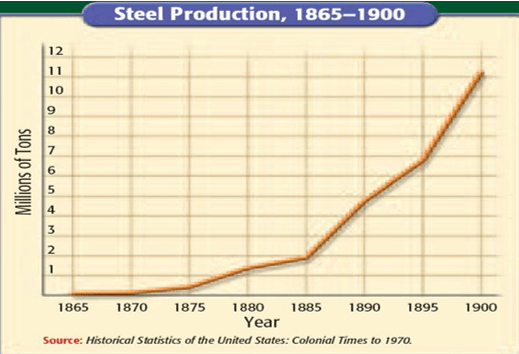
The evidence provided in this graph demonstrated how demand for steel during the Postbellum period led to improved methods, and technological innovation in steel production in the United States. “By the end of the century, the United States was turning out 11,227,000 tons, more than Britain and Germany combined.” [5]
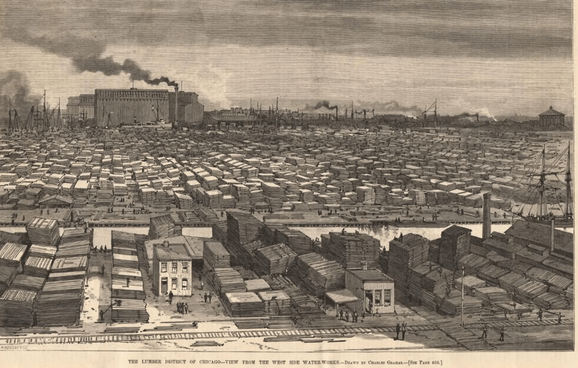
An additional resource that saw a heightened increase in demand during the Postbellum period was lumber. Lumber, like steel is a valuable resource used in the construction of buildings, railroad tracks, furniture, etc. Although not as strong or as durable as steel, new uses of lumber were identified along with new methods of harvesting to meet the increase in demand for this natural resource. The Great Lakes region of the United States was the largest producer of timber and as the following graphic illustrates, lumber production increased from 18,000,000 boards per feet in 1880 to 35,000,000 boards per feet by the close of the 19th century. [6]
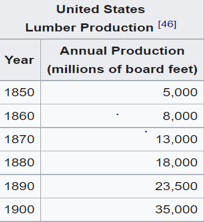
The correlation between the amount of steel and lumber in tons produced between 1880-1900 varies considerably. To accurately compare lumber and steel production in terms of tons produced, we have to convert lumbers board feet to tons. 1200 board feet of lumber is equal to 1 ton. Therefore, 35,000,000 board feet of lumber is equivalent to 29,167 tons. From this perspective, more lumber was produced between 1880-1900. To provide a comparison in terms of revenue, the lumber industry had total capital of $611,611,524 in 1900. [7] Compared to the lumber industries, “the country exported only $6 million worth of iron and steel products in the year before the Civil War, in 1900 the United States exported $122 million worth of locomotives, stationary engines, rails, electrical machinery, wire, pipes, metal-working machinery, boilers, and other goods alone.” [8]
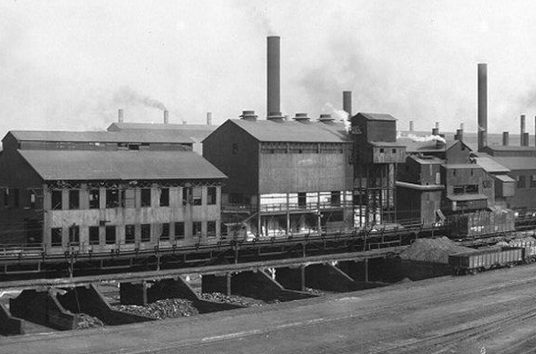
Although the lumber industry experienced record revenues for a short period of time that exceeded the steel industry, the steel industry enjoyed more reliable sustainability and demand along with increasing profits with the mergers of Carnegie Steel Corporation, Federal Steel Company, National Steel Company. These mergers would soon become known as U.S. Steel with a capitalization of $1.4 billion. As a result, the steel industry became the top industry by the close of the 19th century and early 20th century. By 1901, several mergers led by J.P Morgan formed the United Steel Corporation. [9]
7 United States Census. “Lumber.” 1899. Accessed on August 26, 2022. https://www2.census.gov/prod2/decennial/documents/05457254v9ch7.pdf.
8 American Heritage Magazine. “The Age of Steel.” Vol 52, no. 1 (2001): pp1. https://www.americanheritage.com/age-steel.
9 Harvard Business School. “The Founding of U.S. Steel and The Power of the Public Opinion.” Baker Library Bloomberg Center. Last Modified 2022.
5 American Heritage Magazine. “The Age of Steel.” Vol 52, no. 1 (2001): pp1. https://www.americanheritage.com/age-steel.
6 United States Forest Service. The Lumber Cut of the United States. 1907. Government Printing Office. 1908. p. 7.
3 American Heritage Magazine. “The Age of Steel.” Vol 52, no. 1 (2001): pp1. https://www.americanheritage.com/age-steel.
4 United States Census. “Bicentennial Edition: Historical Statistics of the United States, Colonial times to 1970.” September 1975. Accessed on August 29, 2022. https://www.census.gov/library/publications/1975/compendia/hist_stats_colonial-1970.html.
[1] National Material Company. “A Brief History of the American Steel Industry | National Material Company – Steel Processing Facilities.” Last Modified 2022. https://www.nationalmaterial.com/brief-history-american-steel-industry/.
[2] Maritime History. “History of the Great Lakes.” Last Modified Unknown. https://www.maritimehistoryofthegreatlakes.ca/documents/hgl/default.asp?ID=c027.
 The US History Blog