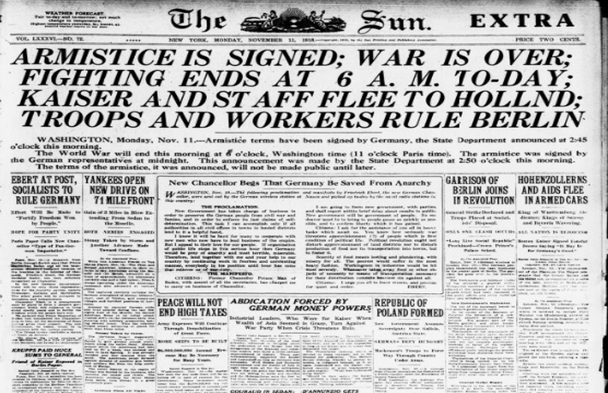
The beginning of the 20th Century could be deemed as a tumultuous time for our young Republic. The devastation and impact of World War I left our country in a mourning and a heightened awareness of how volatile our world has become. Volatile not only in terms of ideologies, but also in terms of economics. It is estimated the cost of World War I for the United States alone was $32 billion which was 52% of the gross national product by the end of the war in 1918. (1) The economic shock of the cost of World War I interrupted global financial markets and set the stage for the Great Depression a decade later.
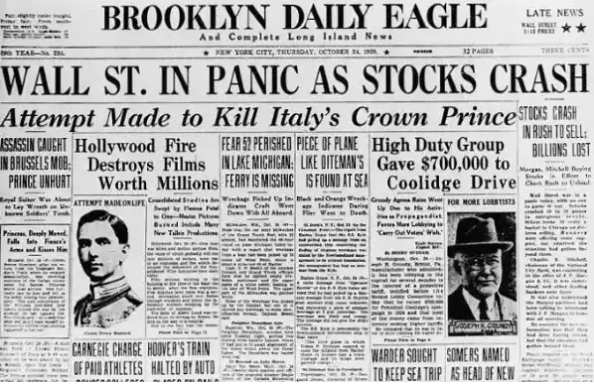
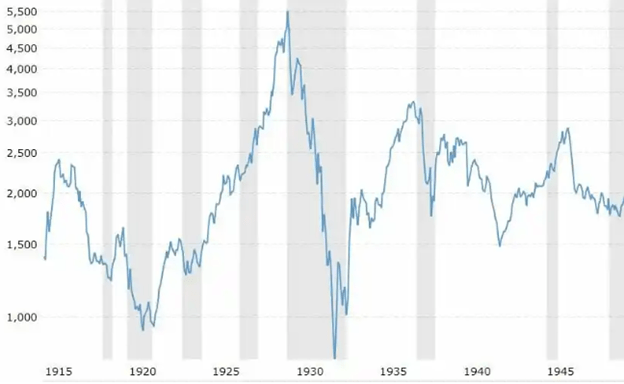
Research pertaining to the causes of the Great Depression is vast and no consensus has been achieved as to its cause. Rarely does any single event cause a significant event such as the Great Depression as numerous factors must be contributing factors. Qualitative and evidence-based research to identify precursors leading up to the Great Depression will need to be examined. The international debt structure at the end of World War I was in a frenzy as Allied European found themselves in significant financial debt to the United States and were unable to pay without depleting their treasuries. Refusing to forgive the debt it was owned, the United States refused to back down and insisted the debts be paid. As U.S. banks began to make loans to European nations, this just added fuel to the fire because these nations were already sinking in war debt to the nation that made the loans and between October 28-29, 1929, the Dow crashed by 25% overnight, down 85% from its 5507 high in August 1929. (2)
Source: Investopedia
Source: Corporate Finance Institute
Unable to pay both the war debt and loan debts, US banks began to fail, along with the decline of export shipping to Europe. (3) In comparison, the use of technology and mass productions grew faster than demand could keep up with. The Roaring Twenties gave witness to many new technological inventions such as the combustible engine and electric railways. It can be assessed these new technologies were produced and deployed faster than what the consumer wanted to adopt. With consumer already strapped for cash, these new products were not being purchased as fast as industry had expected and this resulted in decreasing profits for industries which ultimately led to wide-spread layoffs. Layoffs equal unemployment and for those unemployed who have debt, those debts can’t be paid which further strained the banks to collect depts not only from European nations, but now also from the American consumer.
Many economic theories about as to what caused the Great Depression and no two agree. Unpaid debts to the United States Government from European Allies during World War I, unpaid debt to financial institutions from unemployed workers and the reluctance of the U.S. consumer to purchase newly innovative products are just a few contributing factors that led to the Great Depression. There are lessons to be learned from these causes of the Great Depression which can be applied to us today. We are witnessing a similar trend with new technologies being produced with the increasing push to abolish gas-powered automobiles in favor of new electric vehicles (EV). The cost of an EV as well as the longevity and maintenance expenses involved with ownership far exceed what the average American consumer can or is willing to support. Will the debts of our past wars soon implode our economy? Will we soon experience another Great Depression, and have we not learned the lessons of the past?
(1) National Bureau of Economic Research. “The Economics of World War I.” Last Modified January 1, 2005. https://www.nber.org/digest/jan05/economics-world-war-i.
(2) Corporate Finance Institute. “The Great Depression.” Last Modified December 5, 2019. https://corporatefinanceinstitute.com/resources/knowledge/economics/the-great-depression/.
(3) Almunia, Miguel. “From Great Depression to Great Credit Crisis: similarities, differences and lessons.” Economic Policy. Apr 2010. Pp 219-265. Researchgate. https://www.researchgate.net/publication/227641693_From_Great_Depression_to_Great_Credit_Crisis_Similarities_Differences_and_Lessons.
 The US History Blog